
















Categories
Can You Build a Media Wall in Your Living Room? (Space, Wall Type & Setup Explained)
⏱️ Time to read:
6–9 minutes
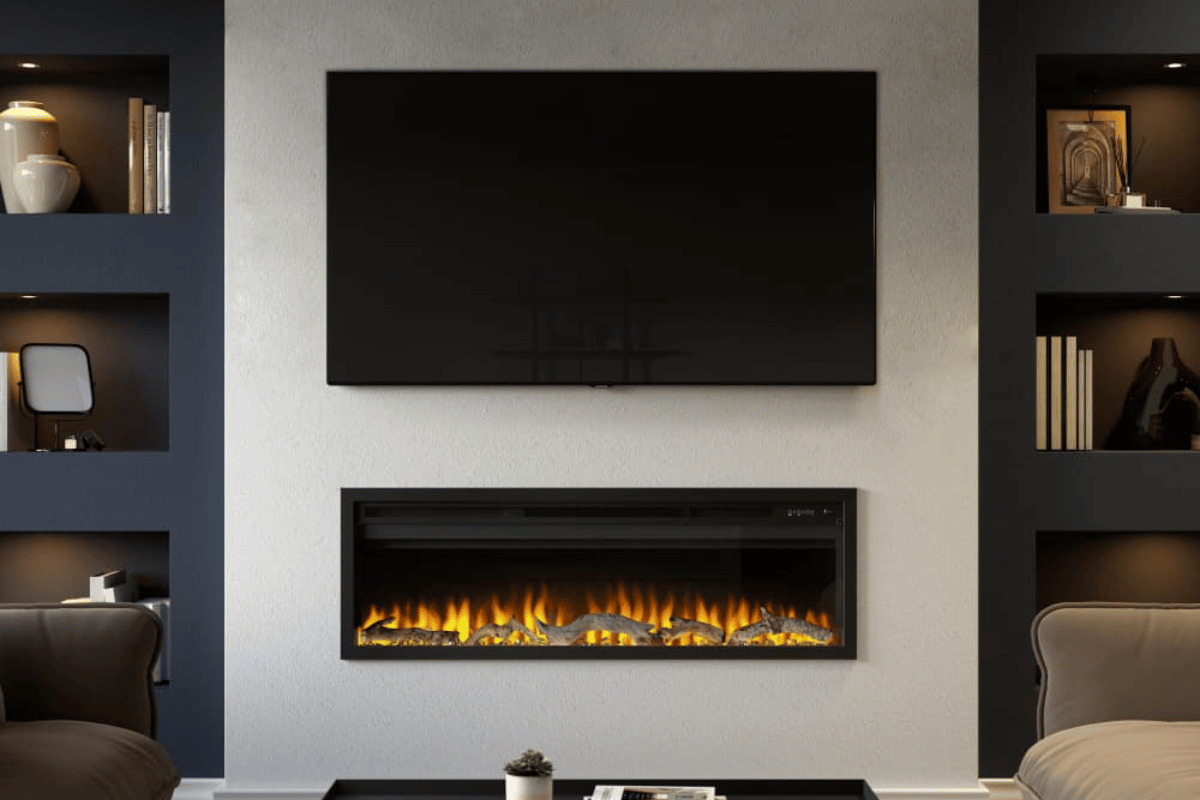
A media wall is a significant structural addition, and the reality is that not every living room can support one. Before you start looking at designs, you must determine if your space has the physical dimensions, structural capacity, and electrical access required. This guide will assess your room’s constraints to give you a definitive answer: yes, you can build one, or no, you probably cannot.
🧠 Quick Answer: Can you build a media wall?
You can build a media wall if:
- Your available clear wall width is at least 1.5 metres.
- You have a minimum viewing distance of 2.0 metres from the screen to your seating.
- You can safely route hidden power cables to the installation area.
- Your floor space can accommodate a 300mm to 500mm depth protrusion without blocking walkways.
You can’t (or shouldn’t) if:
- Your wall is narrower than 1.5 metres (the setup will look cramped and might lack required heat clearances).
- Building the frame outward blocks doors, windows, or primary room walkways.
- You are renting and prohibited from making structural or electrical changes.
- You cannot access or install a dedicated, safe power supply for the TV and fire.
🔑 Key Takeaways
- Minimum wall width: You usually need an absolute minimum of 1.5m of clear wall space, though 2.0m+ is standard for UK homes.
- Wall type dictates the build: Flat walls require a false stud frame built into the room, while existing chimney breasts usually need widening.
- Power is a dealbreaker: You must have accessible, safe electrical points for both the screen and the electric fire. Extension leads are not a safe or compliant solution.
- Viewing distance matters: The size of your TV and fire dictates how far back your seating must be.
- Clear viability: If you lack the width, depth, or electrical access, a media wall is physically not viable for your home.
📍 Jump to section
Check if your room can actually support a media wall before you commit to the build.
The 60-Second Feasibility Checklist
Run through this checklist to instantly qualify your room:
- ✅ Wall Width: Is your clear, uninterrupted wall space 1.5m or wider?
- ✅ Viewing Distance: Is your primary seating at least 2.0m away from the proposed wall?
- ✅ Power Access: Can a qualified electrician route mains power to this specific wall?
- ✅ Wall Type: Is the wall structurally sound (solid brick, blockwork, or load-bearing stud?)
- ✅ Clearances: Can you lose 300mm–500mm of room depth without making the space unusable?
- ✅ Obstructions: Is the area completely free from radiators, windows, and doors?
Your outcome:
- ✅ Mostly Yes: Your room is highly viable. You can move on to our media wall planning guide to map out the specifics.
- ⚠️ Mixed: Possible, but requires compromises (e.g., choosing a much smaller fire, paying to relocate radiators).
- ❌ Mostly No: A media wall is not recommended for this space. Consider a freestanding electric fireplace suite or wall-mounted electric fire with a TV mounted above instead.
Room Constraints: What You Need to Know

1. Wall Width (The Most Critical Factor)
How wide does a wall need to be for a media wall?
To safely house a TV and an electric fire with the necessary structural framework, your wall needs to be a minimum of 1.5 metres wide.
- Under 1.5m: Not viable. There is not enough width to build a stable stud frame that houses a standard TV and fire while maintaining safe structural clearances.
- 1.5 to 2.0m: Viable for compact setups. You will be restricted to media wall fires around 1 metre wide and TVs up to 50 inches.
- 2.0m to 4.0m: The UK standard. This width comfortably fits a 1.2m to 1.5m electric fire and a 55-inch to 65-inch TV.
- 2.4m+: Highly viable. Suitable for panoramic, multi-sided fires (1.5m to 1.8m wide) and extra-large screens.
2. Wall Type
The existing structure of your room dictates how the wall is built.
- Flat walls: Highly viable. You will need to build a false stud wall (timber frame and plasterboard) outward into the room. You must be willing to sacrifice 300mm to 500mm of floor space.
- Chimney breasts: Standard UK chimney breasts (typically 1.2m to 1.6m wide) are often too narrow for modern, panoramic electric fires. You will most likely need to build a wider stud frame around the existing chimney breast to accommodate the fire and TV.
- Stud/partition walls: Viable, but requires reinforcement. Standard partition walls cannot hold the cantilevered weight of a large TV and a heavy electric fire. The internal framework must be reinforced with structural timber before installation.
3. Room Layout & Viewing Distance
A media wall dictates the focal point of the room. Your seating must align with the wall, and the distance between the sofa and the wall must match the TV size.
If building the wall out by 400mm pushes your sofa too close to the screen, the room might not be suitable. Check our TV size guide to ensure your remaining floor space allows for comfortable viewing (typically 2.0m clearance for a 50-inch TV, and 2.5m+ for a 65-inch TV).
4. Power & Electrics
This is a hard constraint. A media wall requires multiple hidden power sockets (usually a minimum of four: TV, electric fire, soundbar, and media box).
- You cannot run trailing extension leads inside a sealed stud wall — this is a severe fire hazard.
- You must have a fused spur or dedicated sockets installed inside the framework.
- If your consumer unit cannot handle the additional load, or if an electrician cannot route cables to the chosen wall, you cannot proceed.
5. Clearances & Proportions
Physical proportions must align. The electric fire should ideally be wider than, or the same width as, the TV above it. If your available space forces you to use a tiny fire beneath a massive TV, the setup will be top-heavy and structurally awkward.
Plus, you must leave adequate clearance between the TV and the fire to prevent heat damage to the TV (although this is not usually a huge distance, as most modern media wall fires project heat forwards rather than upwards).
If your ceiling is too low to accommodate the fire, the heat clearance, and the TV, the project is unlikely to be viable — unless you choose smaller electronics.
So — Can You Build a Media Wall?

Based on the physical constraints above, make your decision:
You can if:
- ✅ You have 1.5m+ of clear wall width.
- ✅ You can sacrifice up to 500mm of room depth.
- ✅ You have or can install safe, hidden mains power.
- ✅ Your seating can be placed 2.0m+ away from the finished wall.
You probably can’t if:
- ❌ Your wall is less than 1.5m wide.
- ❌ The build-out will block a door, window, or radiator.
- ❌ You cannot legally or safely alter the room’s electrics.
- ❌ The room is too narrow, forcing you to sit less than 2.0m from the screen.
If Your Room Fits — Here Are Your Best Options
If you have qualified your room and are ready to proceed, your next step is selecting the hardware. Read our comprehensive media wall fire buying guide to understand the specifications, or browse our media wall fires category page based on your room’s capacity:
- For small walls (1.5m–2.0m): Look for 1m to 1.2m wide fires. These fit perfectly under 50-inch TVs and require minimal framework.
- For medium walls (2.0m–2.4m): Look for 1.2m to 1.5m wide fires. These are the UK standard and balance perfectly with 55-inch to 65-inch TVs.
- For large walls (2.4m+): Look for 1.5m to 1.8m panoramic fires. These are designed for large, open-plan spaces and 75-inch+ screens.
You might also like:
- 👉 Media wall fires: The complete planning guide
- 👉 Step by step guide to building a media wall with a fireplace
- 👉 Media wall fire buying guide
- 👉 How to pick the right TV size for a media wall
- 👉 Media wall mistakes to avoid
- 👉 Media wall layout ideas for living rooms
- 👉 Media wall storage options explained
- 👉 How to choose the right media wall fire flame effect
- 👉 Media wall ideas for the best TV and sports viewing setup
- 👉 Electric fireplace suite vs media wall fire
Need more advice or want to browse in person?
- 📍 Visit us: Shop a selection of media wall fires and get expert advice on building your media wall at our showrooms
- 📧 Get in touch: Contact our team for more information on products, delivery, installation, or finance options
↑ Back to top | Jump to sections ↑
