

















Categories
Should You Keep Your Gas Fire, Upgrade It, or Switch to Electric?
⏱️ Time to read:
10–15 minutes
If you are staring at your current gas fire and wondering what to do with it, you aren’t alone. Whether your current fire is struggling to heat the room, costing too much to run, or simply looking outdated ahead of a living room renovation, deciding what to do next can be frustrating.
Perhaps you are planning a modern media wall and wondering if you need to cap off your gas line. Or maybe you love the heat of gas but hate the draughts coming down the chimney.
This guide is designed to help you make a confident, practical decision. By looking at real-world scenarios, we’ll help you figure out exactly what makes sense for your home — whether that means keeping your current setup, upgrading to a high-efficiency gas model, or making the switch to electric.
🧠 Quick Answer: Should you keep, upgrade, or switch?
- Keep your gas fire if: It is less than 10 years old, glass-fronted, highly efficient, and you still rely on it for fast, powerful heat during the winter.
- Upgrade your gas fire if: Your current model is an older, open-fronted design that loses heat up the chimney. Upgrading makes sense if you want to significantly reduce your heating bills while keeping the authentic flame and high heat output of gas.
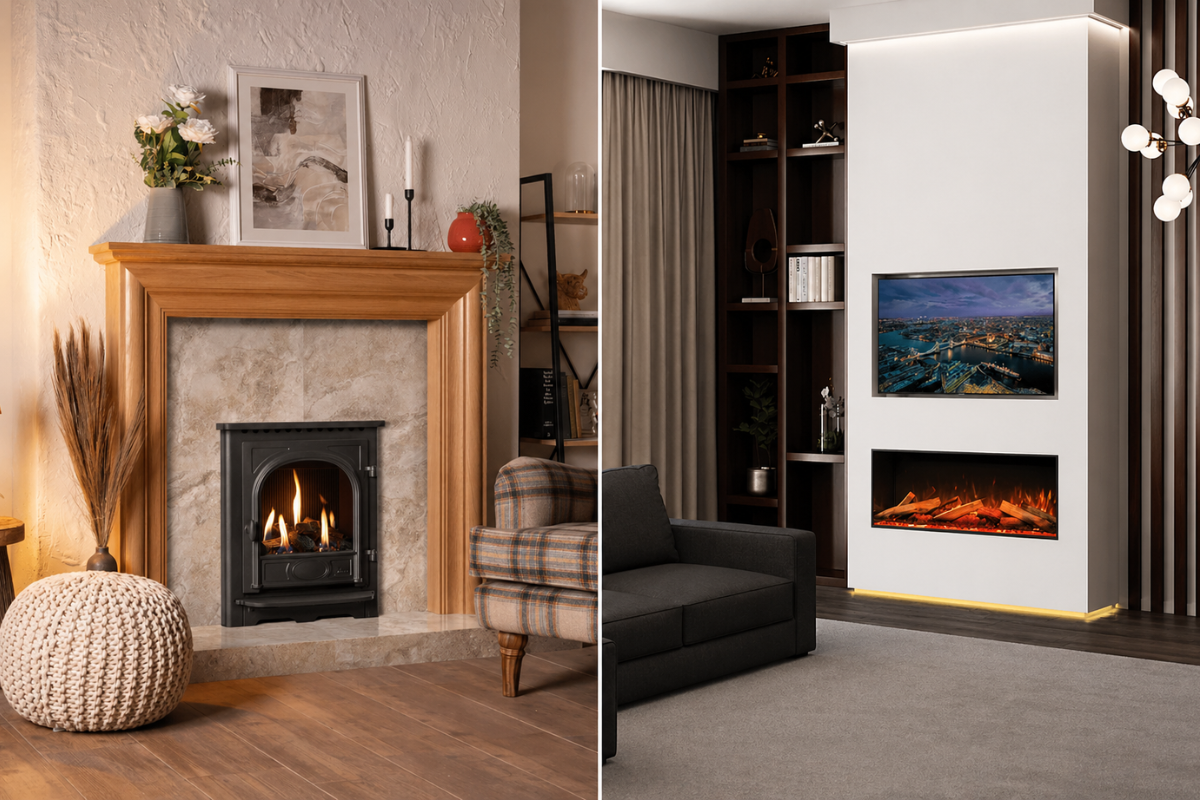
- Switch to electric if: You are renovating (such as building a media wall), you no longer have a working chimney or you want the flexibility to enjoy a flame effect year-round without generating unwanted heat.
🔑 Key Takeaways
- Heat output vs. zone heating: Gas provides powerful, room-filling heat. Electric is ideal for occasional “zone heating” — taking the chill off the room you are in without turning on the central heating.
- Running costs are nuanced: Gas is cheaper per unit (kWh), but older gas fires lose up to 50% of their heat up the chimney. Electric fires cost more per kWh, but are 100% efficient at the point of use.
- Installation complexity: Replacing a gas fire requires a Gas Safe registered engineer and a suitable flue. Electric fires offer plug-and-play simplicity and can be installed on almost any wall.
- Design flexibility: Electric fires dominate modern interior design (especially media walls), while gas fires remain the go-to for traditional fireplace suites and classic aesthetics.
- Maintenance: Gas fires require an annual service to remain safe and efficient. Electric fires require virtually zero maintenance.
📍 Skip to what you need
Not sure whether to keep, upgrade, or switch? Jump straight to the scenario that fits your home.
Scenario 1: When Keeping Your Gas Fire Makes Sense
If your current gas fire is working perfectly, keeping it may be the most sensible option.
You should hold onto your current fire if it is a modern, glass-fronted model. These fires are already highly efficient, retaining most of their heat rather than losing it up the flue. If it still fits your room’s aesthetic and provides reliable warmth without inflating your energy bills, your best course of action is simply to book your annual Gas Safe service and continue enjoying it.
👉 Not ready to replace your fire?
If your current gas fire still works well but feels a bit dated, you don’t necessarily need a full replacement. Simple updates like a new surround, updated interior panels, or a refreshed finish can completely transform the look without the cost of a new unit.
👉 Read our guide to updating a fireplace without replacing it
Scenario 2: When Upgrading Your Gas Fire is the Smart Move

Many homeowners assume that to get a modern, efficient fireplace, they must switch to electric. This isn’t true. If you want to replace a gas fire because it is draughty, expensive to run, or struggling to heat the room, upgrading to a glass-fronted, high-efficiency model is often the smartest move.
Older, open-fronted gas fires are notoriously inefficient — some convert as little as 25% to 50% of the gas they burn into usable heat. The rest escapes up the chimney.
You should upgrade if:
- You want better heat retention: Modern, high-efficiency gas fires (especially glass-fronted models) can reach efficiencies of over 85%, using less gas to produce more heat.
- You love the authentic flame: Nothing quite matches the rolling flames and deep warmth of a real gas fire.
- You already have the infrastructure: If your chimney and gas line are in good condition, swapping an old gas fire for a new, high-efficiency model is a straightforward job for a professional.
👉 Upgrade your gas fire — don’t replace it with compromise
If your current gas fire is underperforming, you don’t need to switch to electric to get better efficiency. Modern high-efficiency gas fires are designed to deliver significantly more heat while using less fuel — without losing the real flame experience.
Scenario 3: When Switching to Electric is the Better Option

The shift toward electric heating is one of the biggest trends in home design right now. If you are planning a renovation, switching to an electric fireplace solves multiple structural and aesthetic problems at once.
You should switch to electric if:
- You are building a media wall: While there are specialist gas fires designed for media walls, electric is by far the most popular and straightforward choice. Standard gas fires generate intense heat that requires careful planning to avoid damaging TVs and soundbars mounted above them. Electric media wall fires, on the other hand, project heat forward or downward, making them perfectly safe for electronics.
- You have no chimney (or a failing one): If your chimney fails a smoke test or you want to install a fire on a flat wall, electric is the easiest route.
- You want year-round ambience: Electric fires allow you to turn on the LED flame effect independently of the heater. You can enjoy the cosy glow in the middle of summer without overheating the room.
- You want complete design freedom: From three-sided panoramic fires to sleek, inset designs, electric fires offer unmatched versatility.
👉 Planning a renovation? Browse our media wall electric fires or complete electric fireplace suites for instant inspiration.
Cost, Efficiency & Running Considerations
It is a common myth that “electric is cheaper” or “gas is better”. The reality depends entirely on how you use your fire.
- The unit cost reality: Gas is significantly cheaper per kWh than electricity. If you are running a fire for several hours a day to heat a large, draughty space, a high-efficiency gas fire will cost less to run.
- The efficiency factor: Electric fires are 100% efficient at the point of use. Every penny you spend on electricity translates directly into heat in your room. Older gas fires waste a large portion of your money straight up the chimney.
- Zone heating: Electric fires excel at zone heating. If you only want to warm the living room for an hour or two in the evening, flicking on a 1kW to 2kW electric fire is often more cost-effective than firing up the central heating for the whole house.
⚠️ Reality Check: Energy costs aren’t just about fuel type — they’re about usage. Two homes with the same fire can have completely different running costs depending on how often, how long, and how much space they’re trying to heat.
Installation & Maintenance Reality

Your decision will also dictate the level of disruption in your home.
- Gas fires: Must be installed by a Gas Safe registered engineer. You will need a suitable, working flue or chimney, and the fire must be serviced annually to ensure it isn’t leaking carbon monoxide.
- Electric fires: Require no flue, no gas pipework, and no annual servicing. While bespoke media walls require some studwork and plastering, the fire itself simply plugs into a standard UK socket or is hardwired by an electrician.
💡 Worth Knowing: If you’re switching from gas to electric, your existing gas fire must be safely disconnected and removed by a Gas Safe registered engineer before installation. This is a quick job in most cases — but it’s an important step to factor into your timeline and budget.
Frequently Asked Questions
Is it worth replacing an old gas fire?
Yes, if your current gas fire is open-fronted, draughty, inefficient, or no longer heating the room properly. A modern high-efficiency gas fire can give you better heat retention while keeping the authentic flame effect of gas.
Should I switch from a gas fire to an electric fire?
Switching to electric makes sense if you are renovating, building a media wall, removing an old chimney, or want a low-maintenance fireplace with year-round flame effects. However, if you rely on your fire for powerful daily heat, upgrading to a high-efficiency gas fire may be the better option.
Are electric fires cheaper to run than gas fires?
Not always. Electric fires are 100% efficient at the point of use, but electricity usually costs more per kWh than gas. Electric can be cost-effective for short bursts of zone heating, while a high-efficiency gas fire is often better for heating larger rooms for longer periods.
Can I replace a gas fire with an electric fire?
Yes, but your existing gas fire must first be safely disconnected and removed by a Gas Safe registered engineer. Once the gas supply is capped off, an electric fire can usually be installed more flexibly, depending on the model and fireplace opening.
Do I need a chimney for an electric fire?
No. Electric fires do not need a chimney, flue, or gas supply. This makes them a strong option for flat walls, media walls, new-build homes, and properties where the existing chimney is blocked, unused, or unsuitable.
Is a high-efficiency gas fire better than electric?
It depends on how you use your fire. A high-efficiency gas fire is usually better if you want strong, room-filling heat and already have a suitable chimney or flue. Electric is often better if you want design flexibility, easier installation, and flame effects without heat.
Can you put a gas fire in a media wall?
Yes, but it requires careful planning. Gas fires produce more intense heat and need suitable ventilation, clearances, and professional installation. For most media wall projects, electric fires are the simpler and more popular choice.
What’s Your Next Step?
The right choice ultimately depends on your home, your heating needs, and your design goals — not a one-size-fits-all answer.
- Want powerful heat and lower gas bills? Don’t switch fuels — upgrade your outdated model.
- Want a traditional look with zero maintenance? A complete suite is the perfect focal point.
- Planning a modern living room renovation or TV feature wall? Electric is the way to go.
- Still unsure? Browse our full collections to see what catches your eye.
You might also like:
- 👉 Gas vs electric fires compared
- 👉 Electric fire buying guide
- 👉 Gas fire types guide
- 👉 Media wall fire buying guide
- 👉 High-efficiency gas fires explained
- 👉 Best contemporary gas fires for modern homes
- 👉 What are your options for a gas fire without a chimney?
- 👉 Electric suite vs media wall fire: which is right for your home?
- 👉 How to choose the right electric fireplace suite
- 👉 What types of fires can you use in a media wall?
- 👉 Media wall complete planning guide
- 👉 How to update your fireplace without replacing it
Need more advice or want to browse fires in person?
- 📍 Visit us: Explore a collection of gas and electric fires and get expert, personalised advice at our showrooms
- 📧 Get in touch: Contact our team for product advice, delivery enquiries, installation questions, or for more information on finance options
↑ Back to top | Jump to sections ↑
