
















Categories
Media Wall Fires: The Complete Planning Guide (Before You Buy Anything)
⏱️ Time to read:
14–21 minutes
Everyone loves the idea of a media wall. A quick scroll through Pinterest or Instagram shows hundreds of flawless, cosy living rooms with perfectly balanced screens and stunning flames. But the reality of building one? Without the right planning, you could end up with a TV mounted so high it causes neck strain, an electric fire that looks awkwardly out of place, or a setup that doesn’t provide the heat you expected.
Most media wall mistakes happen long before you even buy the fire. They happen in the planning phase.
This guide is designed to help you plan your project properly from day one. We’ll cover everything most people wish they knew before building a media wall, helping you avoid expensive regrets and get that picture-perfect finish.
🧠 Quick Answer: What is a media wall?
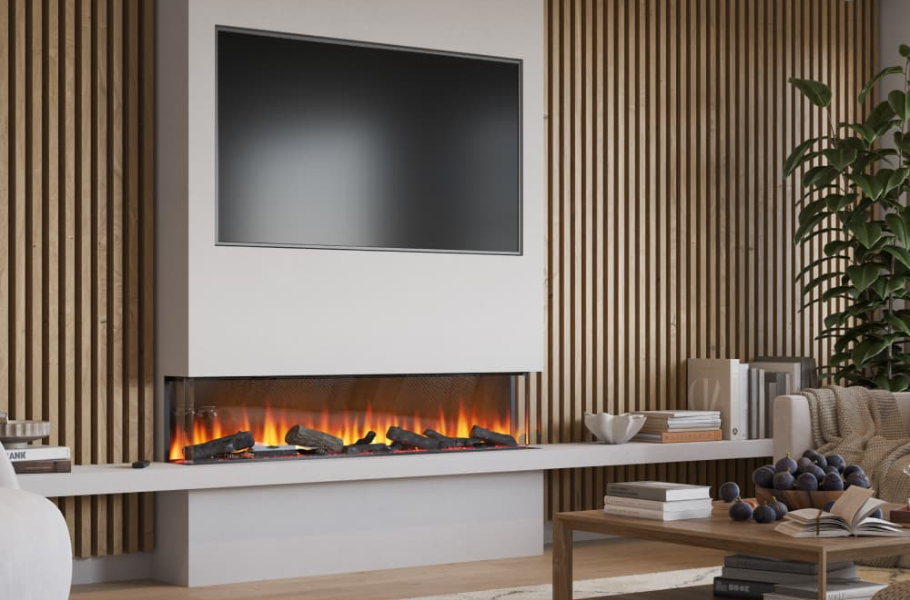
A media wall is a built-in feature wall that combines a flat-screen TV, an electric fire, and optional storage or shelving into a single, integrated design. It is typically constructed using studwork and plasterboard, creating a clean, modern focal point in a living room, dining room, or bedroom.
While they do provide some heat, media walls are designed for visual impact first and heating second.
🔑 Key Takeaways
- Always choose your electric fire first. It dictates the size, proportions, and layout of your entire media wall.
- Your fire should be wider than your TV to create a balanced, premium look. A smaller fire will make the wall feel top-heavy.
- Media wall fires are not primary heaters. Most output 1kW–2kW, so they’re designed for ambience, not whole-room heating.
- Labour and installation are often underestimated. Build and fitting costs can add up faster than expected.
- Common mistakes include poor sizing, TV mounted too high, and overcomplicated designs. These can all ruin the final look.
- A well-planned media wall is about proportions and layout, not just picking a nice fire or copying a Pinterest design.
📍 Jump to what matters
Short on time? Skip straight to the bits you need to know.
- What Size Media Wall Fire and TV Do You Need?
- Heat Output Myths: Do Media Wall Fires Heat a Room?
- How to Build a Media Wall
- Common Media Wall Mistakes
- Cost Expectations: How Much Does a Media Wall Cost?
- Choosing the Right Electric Fire for a Media Wall
- Media Wall Design Ideas
- Should You Build a Media Wall?
- Frequently Asked Questions About Media Wall Planning
- Plan Your Media Wall the Right Way
What Size Media Wall Fire and TV Do You Need?
If there is one thing people obsess over, it’s getting the proportions right. Buying a bigger or smaller TV is easy; resizing a built-in stud wall is a massive job. Always buy the fire first.
The Golden Ratio of Media Wall Sizing
Your electric fire should match or exceed the width of your TV — avoid going smaller.
While older trends sometimes suggested a slightly smaller fire, modern interior design dictates that it needs to act as a visual anchor. A fire that is wider than the screen above it creates a stable, balanced, and more premium look.
For the best visual balance, your TV’s width should be roughly 70–100% of the fire’s width. You should avoid a TV that is wider than the fire below it. Think of your media wall like a pyramid: the wider base (the fire) supports the slightly narrower top (the TV). If you flip that, the whole structure looks top-heavy and unbalanced.
Match your TV to your fire width:
- 43” TV (approx. 953mm wide): Pair with a 1000–1100mm fire
- 50” TV (approx. 1107mm wide): Pair with a 1200–1300mm fire
- 55” TV (approx. 1217mm wide): Pair with a 1300–1500mm fire
- 65” TV (approx. 1400mm wide): Pair with a 1500–1800mm fire
- 75” TV (approx. 1661mm wide): Pair with a 1800–2000mm fire
The most common mistake: Placing a tiny electric fire under a massive TV. It makes the fire look like an afterthought.
For the best visual balance, panoramic, edge-to-edge glass designs offer a cleaner, more modern look that complements flat-screen TVs perfectly.
👉 Not sure what TV size works best?
Getting the proportions right is everything. Our guide breaks down the ideal TV sizes for your media wall, so you avoid a setup that looks awkward or feels uncomfortable to watch.
Heat Output Myths: Do Media Wall Fires Heat a Room?
Quick Answer: Yes — but only as a secondary heat source. Most electric fires produce 1kW–2kW of heat, which is enough to take the chill off a room but not replace central heating.
People choose media wall fires for the flame visuals, ambience, and architectural design rather than for primary heating. Understanding this before you buy will save you from disappointment and ensure you’re choosing the fire for the right reasons.
💡 Worth knowing: Flame-only mode costs just pennies to run, so you can use your fire year-round without worrying about bills.
How to Build a Media Wall (Basic Step-by-Step)
Building a media wall doesn’t have to be intimidating. Here is the standard process:
- Build the stud wall: Create the timber frame to your specific dimensions.
- Run the electrics: Put plug sockets and cable management in place.
- Install the fire: Fit the electric fire into its designated opening.
- Mount the TV: Secure the bracket and screen above the fire.
- Finish the surface: Plasterboard, skim, and decorate.
Crucial considerations:
- Power supply positioning: Keep sockets accessible but hidden.
- Access panels: Future-proof your wall in case a cable fails or you upgrade your TV.
- Clearance requirements: Always check the manufacturer’s manual for the exact distance required between the fire and the TV.
👉 Thinking about professional installation?
A media wall needs more than just good design — it needs precise building, safe electrics, and a clean finish. Our installation service helps you get it right first time, without the stress or costly mistakes.
Common Media Wall Mistakes (What to Avoid)
Don’t be the person who spends thousands only to end up with a room that doesn’t look or feel right. Avoid these classic errors:
- TV mounted too high: This is the #1 mistake. It causes neck strain and looks awkward. Your TV should be at a comfortable eye level from your sofa.
- Fire too small: As mentioned, a fire narrower than your TV makes the wall look top-heavy and breaks the whole aesthetic.
- Not enough depth: If your stud wall isn’t deep enough, your fire will protrude awkwardly instead of sitting flush.
- Ignoring heat clearance: Failing to leave a gap between the heater and the TV can damage your screen. While media wall electric fires are designed to be safe to mount under a TV, they do have minimum clearance distances.
- Overcomplicating the design: Too many illuminated shelves, mixed textures, and flashing LEDs can make the wall look cluttered.
💡 Worth knowing: Bigger isn’t always better — an oversized TV in a small room can feel overwhelming and uncomfortable to watch.
Cost Expectations: How Much Does a Media Wall Cost?
The cost of a media wall varies wildly depending on who builds it and what materials you use. The biggest mistake people make is underestimating labour. While fires can range from a few hundred pounds to £2,000+, the build and installation costs often add up faster than expected.
- DIY build (materials only): ~£500–£1,500
- The electric fire: £300–£2,000+
- Full professional install (labour + materials + fire): £2,000–£5,000+
What drives the cost?
The size and brand of the fire, the complexity of the design (e.g., adding custom alcoves), the materials used (veneer panelling vs. standard paint), and local tradesperson labour rates.
💡 Worth knowing: It’s often the finishing touches that push costs up — plastering, electrics, and decorating can quietly add hundreds if not planned in from the start.
Choosing the Right Electric Fire for a Media Wall
When shopping for an electric fire for a media wall, you need a unit specifically designed to be built-in — not a standard freestanding electric fire.
What to look for:
- Landscape design (1-sided, 2-sided, or 3-sided glass)
- High flame realism (LED, rotisserie, or holographic technology)
- Adjustable brightness and colour settings
- Remote or smart app control
- A “flame-only” mode (so you can enjoy the visuals in summer without the heat)
Popular sizes:
- 1000mm to 1250mm: Great for standard living rooms, pairing perfectly under TVs up to 50 inches.
- 1500mm: The sweet spot for most modern homes. This size looks incredible sitting beneath a 55-inch or 65-inch TV.
- 1800mm+: Perfect for grand, full-width feature walls and massive 75-inch+ screens.
👉 Exploring other fire options for a media wall?
Electric fires are the most popular choice, but they’re not the only option. This guide covers all compatible fire types, helping you understand what works, what doesn’t, and why.
Media Wall Design Ideas
Need some inspiration? Here are the most popular styles right now:
- Minimalist: A clean, plastered, and painted wall with a flush TV and a seamless built-in electric fire for a media wall.
- Panelling feature wall: Using acoustic wood slat panels behind the TV for texture and warmth.
- Shelving + storage: Adding symmetrical alcoves on either side for logs, ornaments, or sound systems.
- Small room ideas: If you’re short on space, look for slimline fires, compact layouts, and keep the focus purely on the TV and fire without extra shelving.
💡 Worth knowing: The best layout isn’t the busiest one — it’s the one that fits your room. If your space is small, keeping it simple will always look more intentional than trying to squeeze in every design feature.
Should You Build a Media Wall?
It’s right for you if:
- You want a stunning focal point in your living room.
- You prioritise aesthetics, ambience, and modern design.
- You understand the heat limitations of electric fires.
It might not be for you if:
- You need a serious, high-output heating source.
- You prefer flexibility and like to rearrange your living room furniture frequently.
Frequently Asked Questions About Media Wall Planning
What size electric fire do I need for a media wall?
Your electric fire should be similar in width or wider than your TV to create a solid visual base and prevent the wall from looking top-heavy. For example, a standard 55-inch TV is roughly 1230mm wide, so it pairs beautifully with a 1500mm electric fire.
Can a media wall heat a room?
Yes, but they act as a secondary heat source. Most media wall fires output between 1kW and 2kW of heat, which is enough to take the chill off a room but not enough to replace your central heating.
How deep should a media wall be?
A media wall is typically 300mm to 400mm deep. This allows enough space to house the depth of the electric fire, the TV bracket, and the necessary cabling without the appliances protruding.
Are media walls expensive to run?
If you are only using the flame-effect mode without the heater, they are very cheap to run (often just pennies an evening thanks to LED technology). Running the 2kW heater will cost more, depending on your current electricity tariff.
Can you install a media wall in any room?
Yes. Because electric fires do not require a chimney or flue, a media wall can be installed in almost any room — including living rooms, bedrooms, and extensions — provided you have access to a standard electrical supply.
What are common media wall mistakes?
According to our experts, the most common mistakes that ruin the look of a media wall include:
- TV too small for the wall: It ends up looking lost in the space.
- TV too high: This is a rookie error that causes immediate neck ache.
- Fire too small for the TV: This creates a “looming”, top-heavy effect where the TV dwarfs the fire.
- No spacing between elements: This looks cramped and can become a heat hazard.
- Ignoring seating position: Buying a massive TV when your sofa is too close.
What are the downsides of a media wall?
The main downside is their permanence. Because media walls are custom-built from timber and plasterboard, upgrading to a different fire or a significantly larger TV in the future can be difficult if you haven’t left enough breathing room in your initial design.
Can you buy a ready-made media wall?
Yes. If you want to avoid the mess and expense of building a custom stud wall, you can purchase freestanding, pre-built units. They house an electric fire and feature space for a TV to sit on top or be mounted directly above, giving you a similar focal point without the construction work.
Are media walls still trendy?
Yes, they remain incredibly popular in UK homes. They are the modern solution to a common living room problem: how to feature both a large flat-screen TV and a cosy fireplace without them competing for space.
Do media walls add value to a house?
While it depends on the local property market, a well-designed, professionally finished media wall creates a stunning “wow factor” and a balanced focal point that appeals to modern buyers. However, a poorly planned media wall — such as one with a TV mounted far too high or unbalanced proportions — can be off-putting to potential buyers who might see it as something they need to tear down.
What to have instead of a media wall?
If a built-in media wall isn’t right for your space, there are plenty of alternatives that still offer a great focal point. You could opt for a wall mounted electric fire, freestanding electric fireplace suite, or a hole-in-the-wall gas fire. Alternatively, you can stick to a traditional setup with a classic limestone or marble fireplace package on one wall, and a standard freestanding TV unit on another.
Plan Your Media Wall the Right Way
A great media wall isn’t about copying a Pinterest design — it’s about getting the proportions, layout, and expectations right from the start.
Choose your fire first, size everything around it, and keep the design clean and intentional. That’s what separates a media wall that looks “okay” from one that feels properly built.
More media wall guides
- 👉 Step-by-step guide to building a media wall
- 👉 Media wall electric fire buying guide
- 👉 How much does building a media wall cost?
- 👉 Guide to media wall storage options
- 👉 Guide to building a media wall for gamers
- 👉 Popular colour schemes for media walls
- 👉 The most important features for a media wall fire
Need expert advice?
- 📍 Visit us: See our media wall fires and displays in person at our showroom
- 📧 Get in touch: Not sure where to start? Speak to our team for friendly, expert advice
↑ Back to top | Jump to sections ↑
