















Categories
Electric vs Gas vs Bioethanol Fires: Which Is Right for Your Home?
⏱️ Time to read:
12–18 minutes
Most people choose a fireplace based on looks alone. They scroll through Pinterest or Instagram, fall in love with a stunning floor-to-ceiling media wall or a sleek, open-flame centrepiece, and hit “buy.”
Then reality sets in.
They discover their chimney is condemned, the installation will cost three times the price of the fire itself, the room turns into an unbearable sauna after twenty minutes, or their landlord strictly forbids any structural changes.
Here is the golden rule of fireplace shopping: You don’t choose the best fireplace. You choose the best fireplace for your situation.
Buying the right fire means working backward from your actual life. It means looking at your home’s architecture, your heating needs, your budget, and your lifestyle — and matching those realities to the right fuel type. Get this right, and you’ll have a stunning focal point that adds value to your home and joy to your evenings. Get it wrong, and you’ll have an expensive mistake sitting unused in your living room.
🧠 Quick Answer: Which fireplace is right for you?
If you are short on time and want the bottom line, here is the fastest way to make your decision:
- If you want the easiest installation: → Electric
- If heat output matters most: → Gas
- If flexibility and design freedom matter most: → Bioethanol
🔑 Key Takeaways
- Electric fires are usually easiest to install: They require no chimney, no flue, and can be plugged into a standard socket.
- Gas fires typically produce the strongest heat output: They are the best choice if you want to genuinely heat a large room rather than just decorate it.
- Bioethanol fires offer real flames without a chimney: They burn clean liquid fuel, making them perfect for architectural, flueless designs.
- Media wall electric fires suit modern renovations: They allow you to safely mount a TV directly above the fire without heat damage.
- Renters usually benefit from electric or bioethanol: Both options offer freestanding or plug-and-play models that can move with you.
- Running costs vary depending on fuel prices and usage: Gas is often cheaper per kilowatt of heat, but electric fires offer a “flame-only” setting that costs pennies to run.
📍 Find what you need
Choosing a fireplace? Jump straight to the section that matches your home, heating needs, and installation limits.
- How to Choose the Right Fireplace Type
- Quick Comparison Table
- Which Fire Fits Your Situation?
- Easiest Installation
- Best for Heat Output
- No Chimney or Gas Connection
- Best Fireplaces for Renters
- Best for Aesthetics
- Frequently Asked Questions
- Still Not Sure? Use This Shortcut
- Making the Right Choice for Your Home
How to Choose the Right Fireplace Type for Your Home

The wrong fireplace choice usually comes from asking the wrong questions. If your first question is “Which one looks the coolest?” you are already heading down a risky path.
To find the perfect fit, you need to step back and ask yourself a few practical questions: How much heat do you actually need? Can your home support the installation requirements of a gas line or flue? Is everyday convenience more important to you than the realism of a physical flame? Are you undertaking a massive renovation, simply upgrading an old hearth, or renting a property where structural changes are banned?
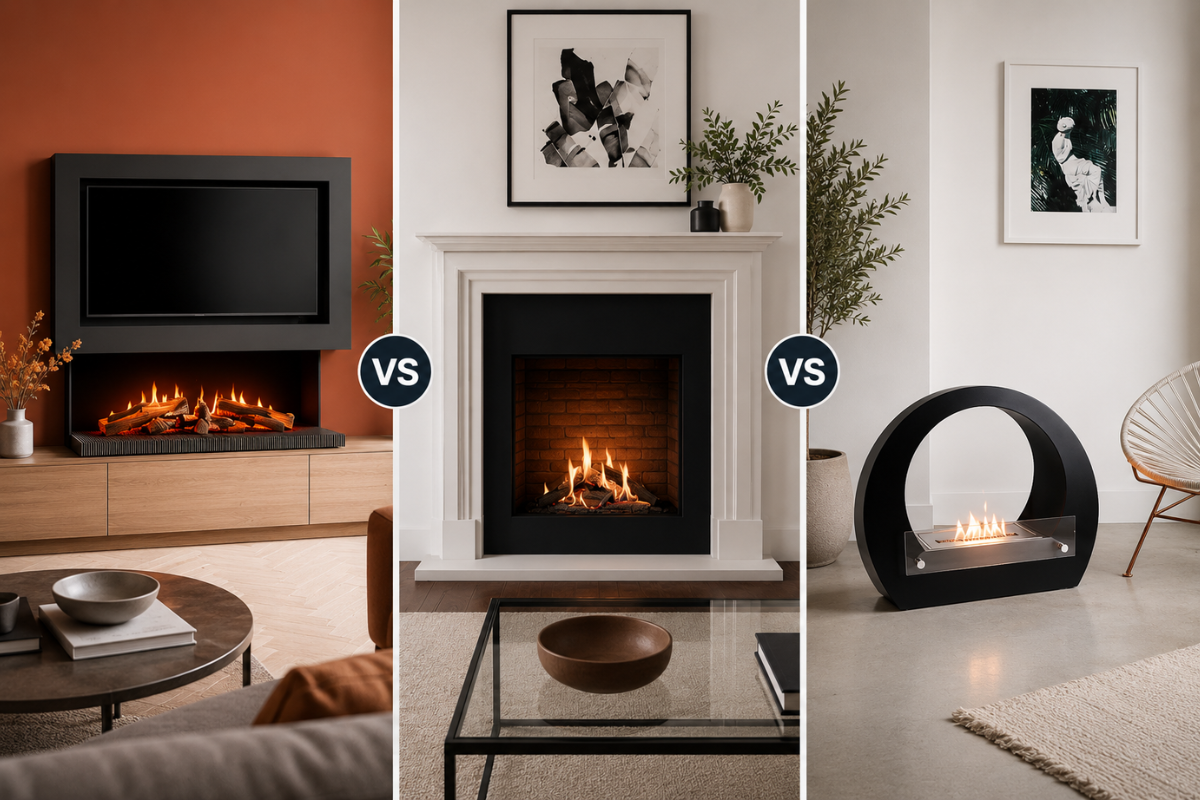
By answering these questions, the “right” choice will naturally reveal itself. To help you visualise the differences, let’s look at how the three main fuel types stack up against each other.
Quick Comparison Table
| Feature | Electric | Gas | Bioethanol |
|---|---|---|---|
| Installation Difficulty | Low (Plug & Play) | High (Requires Gas Safe engineer & flue) | Low to Medium (No flue, but needs safe housing) |
| Heat Output | Low to Medium (up to 2kW) | High (Often 3kW to 6kW+) | Medium (Usually 2kW to 3kW) |
| Flame Realism | Simulated (LED/Vapour) | Real Flame | Real Flame |
| Maintenance | Minimal (Dusting) | Annual Gas Servicing required | Minimal (Cleaning burner, refilling) |
| Ease of use | Remote/App/Voice control | Remote/Slide control | Manual lighting and refuelling |
| Best For | Media walls, apartments, convenience | Primary room heating, traditional homes | Architectural designs, no-chimney homes |
| Suitable for Renters | Yes (Freestanding/Suites) | Not usually | Yes (Freestanding models) |
The Winners:
- 🏆 Best Heat: Gas
- 🏆 Best Convenience: Electric
- 🏆 Best Flexibility: Bioethanol
Which Fire Fits Your Situation?
The best option depends less on the fire itself and more on how you’ll actually use it. A top-of-the-line gas fire is useless in a modern high-rise apartment without a flue. A stunning bioethanol fire might frustrate someone who just wants to press a button on a remote control without handling liquid fuel.
Let’s break down the most common real-life scenarios to help you find your match.
“I want the easiest installation possible”

Recommendation: Electric
If the thought of knocking down walls, hiring specialised engineers, and dealing with building regulations makes you break out in a cold sweat, electric is your answer.
Electric fires offer ultimate plug-and-play convenience. Because there is no real combustion happening, there are no emissions. That means no chimney, no flue, and no complex ventilation requirements. In many cases, installing an electric fire is as simple as taking it out of the box, pushing it against a flat wall, and plugging it into a standard 13-amp socket.
This makes electric fires the undisputed champions of modern home renovations, particularly for media walls. A media wall involves building a false stud wall to house a wide, panoramic fire with a television mounted directly above it. Because electric fires push their heat out from the front (and can be run with the heat turned completely off), they won’t melt your expensive OLED TV.
Plus, if you are simply looking to upgrade an old, draughty fireplace, an electric inset fire can often be slid straight into the existing opening with no fuss.
If/Then Decision Shortcut:
If you:
- Are renovating on a budget
- Want minimal disruption to your home
- Want a quick, same-day install
Then:
- Electric is likely your best option.
👉 Ready to skip the installation hassle? Browse our collection of Electric Fires and discover plug-and-play models, inset options, and media wall designs built for effortless upgrades.
“I actually want heat — not just decoration”

Recommendation: Gas
Modern homes are incredibly well insulated, which is why many people only need a fireplace for ambient lighting and atmosphere. However, if you live in an older property with high ceilings, draughty windows, or a large open-plan space, you might actually need your fireplace to do some heavy lifting when the temperature drops.
If heat performance matters most, gas is the undisputed king.
While electric fires are typically capped at around 2kW of heat output (essentially the same as a standard fan heater), gas fires can comfortably push out 4kW, 5kW, or even 6kW of heat. Plus, gas provides a different type of warmth. It offers deep, radiant heat that warms the objects and people in the room, alongside convected heat that warms the air itself.
Gas fires also offer the traditional charm of a real, dancing flame over a ceramic log or coal bed. Modern gas-fronted fires are incredibly efficient, meaning the vast majority of the heat generated is pushed into your room rather than being lost up the chimney.
If/Then Decision Shortcut:
If:
- Heat performance matters most
- This fire is replacing your primary heating in that room
- You plan to use it daily during the winter
Then:
- Gas is likely the better fit.
👉 Need a fireplace that delivers more than just ambience? Explore our range of Gas Fires and discover high-output models designed for powerful heating, realistic flames, and everyday comfort.
“I don’t have a chimney or gas connection”

Recommendation: Electric or bioethanol
Historically, not having a chimney meant you couldn’t have a fireplace. Today, that simply isn’t true. If you live in a new-build home, an apartment, or a house where the chimney was removed decades ago, electric or bioethanol fires are great options.
Your decision here comes down to one simple split: Do you want ultimate convenience, or do you want real flames and design flexibility?
Want convenience? → Go Electric
As mentioned earlier, electric fires require zero venting. You get instant ambience at the touch of a button, smart-home integration, and the ability to enjoy the visual effect of a fire in the middle of summer without overheating your room.
👉 Prefer instant ambience without installation headaches? Explore our Electric Fires collection for plug-and-play designs, smart features, and stylish options perfect for homes without a chimney.
Want real flames and design flexibility? → Go Bioethanol
If you are a purist who cannot stand the idea of an artificial LED flame, bioethanol is a revelation. Bioethanol is a renewable liquid fuel derived from agriculture. When it burns, it produces a real, natural flame, but the only emissions are heat, a tiny amount of water vapour, and roughly the same amount of carbon dioxide as a human exhales.
Because there is no smoke, soot, or dangerous carbon monoxide, bioethanol fires do not require a chimney or flue. This opens up incredible architectural possibilities. You can have a double-sided fire dividing a dining and living space, a fire suspended from the ceiling, or a sleek ribbon of flame integrated into a custom stone countertop.
If/Then Decision Shortcut:
If you want:
- A real, physical flame without the need for a chimney
- Bespoke, architectural design freedom
Then:
- Bioethanol is the way to go.
👉 Love the idea of real flames without a flue? Discover our Bioethanol Fires collection and explore contemporary designs that offer complete freedom for modern spaces.
“I’m renting and can’t make structural changes”
- Primary Recommendation: Electric
- Secondary Recommendation: Bioethanol
Renters often assume they are locked out of the fireplace market. Landlords generally do not take kindly to tenants knocking holes in walls or installing gas appliances. Fortunately, you don’t need to make structural changes to enjoy a fireplace.
Your primary recommendation is an electric fire. Specifically, look at freestanding electric stoves or complete electric fireplace suites. A suite is a fireplace that comes pre-assembled with the surround, back panel, hearth, and fire all in one unit. You simply place it flat against the wall and plug it in. When your tenancy ends, you unplug it and take it with you to your next home.
Your secondary option is a freestanding bioethanol fire. These come in various sizes, from small tabletop burners to large, floor-standing statement pieces. They require no installation whatsoever and offer the luxury of a real flame in a rental property.
Just ensure your room meets the minimum cubic volume requirements for the specific burner, as bioethanol fires consume oxygen.
💡 Worth Knowing: Before buying a bioethanol fire for a rental property, always check the manufacturer's room size guidance and ventilation recommendations. While bioethanol fires do not require a chimney or flue, they use oxygen during operation, making proper room volume and airflow important for safe, comfortable use.
“I care most about aesthetics”
If you are designing a room from scratch, the fireplace will dictate the entire aesthetic of the space. Here is how to match the fuel type to your interior design vision:
- Modern media wall style → Electric: If you want the ultra-contemporary look of a wide, panoramic fire sitting flush beneath a flat-screen TV, electric is the only sensible choice. The heat management is safe for electronics, and you can customise the flame colours to match your mood or décor.
- Contemporary minimalist look → Bioethanol: If you want a sleek, Scandinavian-inspired space with clean lines and no visible grilles, glass, or frames, bioethanol is perfect. A simple, open ribbon of real fire sitting in a raw concrete or marble plinth is the ultimate minimalist statement.
- Traditional realism → Gas: If you live in a period property, a Victorian terrace, or a country cottage, you likely want a traditional cast iron insert or a classic stone surround. Gas fires offer the most authentic, traditional look, complete with glowing ceramic embers that closely mimic a real coal or wood fire.
Frequently Asked Questions (FAQ)
Which fireplace is cheapest to run?
This entirely depends on fuel prices and your usage habits. Gas is generally the most cost-effective per kilowatt if you are actively using it to heat a room. However, electric fires give you the ultimate control: you can turn the heat completely off and run the “flame-only” effect for just a few pennies an evening. Bioethanol fuel is a premium product, making it the most expensive to run if used daily, so it is better suited for occasional, atmospheric use.
Which fireplace gives the most heat?
Gas generally delivers the strongest heat output. While electric fires max out around 2kW, gas fires can easily exceed 5kW, providing deep, radiant warmth that can heat large spaces efficiently.
Which fireplace is easiest to install?
Electric. There are no flues, no gas pipes, and no building regulations to navigate. Most models simply require a standard plug socket and a flat wall.
Which looks most realistic?
Gas offers the most realistic traditional fire experience, with genuine flames interacting with highly detailed ceramic logs. However, premium electric fires using 3D vapour technology, where light is projected onto fine water mist, are incredibly convincing. Bioethanol offers a real flame, but it tends to be a cleaner, more uniform yellow/orange flame rather than the varied, smoky look of a wood fire.
Still Not Sure? Use This Shortcut
If you are still weighing up your options, use these final decision blocks to lock in your choice:
If you want:
- Easiest installation
- Media wall design
- Convenience and smart controls
- Flame-only settings for year-round use
👉 Choose Electric
If you want:
- Serious heating performance
- Traditional realism
- Radiant warmth for a large room
👉Choose Gas
If you want:
- Real flames
- No chimney or flue required
- Architectural, minimalist design
👉 Choose Bioethanol
Making the Right Choice for Your Home
There is no universally “best” fireplace. The perfect fire for a modern city flat is completely different from the perfect fire for a draughty country farmhouse.
The right choice depends entirely on your installation constraints, heat requirements, lifestyle, desire for convenience, and design priorities. By ignoring the temptation to buy based on looks alone, and instead focusing on how the fire will function in your specific space, you dramatically increase the chances of choosing something you will love for years to come. Choosing correctly now avoids expensive installation headaches and daily disappointment later.
Ready to find the right fit? Explore our comprehensive ranges, compare styles, and discover the best option for your home setup.
- 👉 Browse our Electric Fires for plug-and-play convenience
- 👉 Explore our Gas Fires for unbeatable heat and realism
- 👉 Discover our Bioethanol Fires for flueless architectural freedom
Your perfect evening by the fire is just a few clicks away.
You might also like:
- 👉 Can you build a media wall in your living room?
- 👉 Should you keep your gas fire, upgrade it, or switch to electric?
- 👉 High-efficiency gas fires explained
- 👉 Electric fireplace suite vs media wall fire for your home
- 👉 Which electric fireplace suite should you buy?
- 👉 Which electric fires look most realistic?
- 👉 Electric fire buying guide
- 👉 Which gas fire type is best for you?
- 👉 Bioethanol fires buying guide
- 👉 What is bioethanol?
- 👉 Gas or electric fires: Which is best?
- 👉 Living in a rented house? Best fireplaces for renters
- 👉 Media wall complete planning guide
↑ Back to top | Jump to sections ↑

Related posts:
 Everything You Need to Know About Opening Up an Old Fireplace
 How to Update Your Fireplace Without Replacing It (Tiles, Surrounds & Easy Upgrades)
 Can You Build a Media Wall in Your Living Room? (Space, Wall Type & Setup Explained)
 Bioethanol Fires Buying Guide: Everything You Need to Know Before You Buy