


















Categories
How Much Do Electric, Gas & Bioethanol Fires Cost to Run? (UK Comparison)
⏱️ Time to read:
7–11 minutes
Choosing a fireplace is exciting until one question ruins the mood: how much is this thing actually going to cost me every month?
Most people assume electric fires are expensive because electricity prices are high, or think bioethanol must be cheaper because there’s no installation. But real-world running costs are often very different from expectations.
Whether you want a fire for cosy evenings, daily heating or pure ambience, here’s what electric, gas and bioethanol fires actually cost to run in the UK.
🧠 Quick Answer: How do the different fireplace running costs compare?
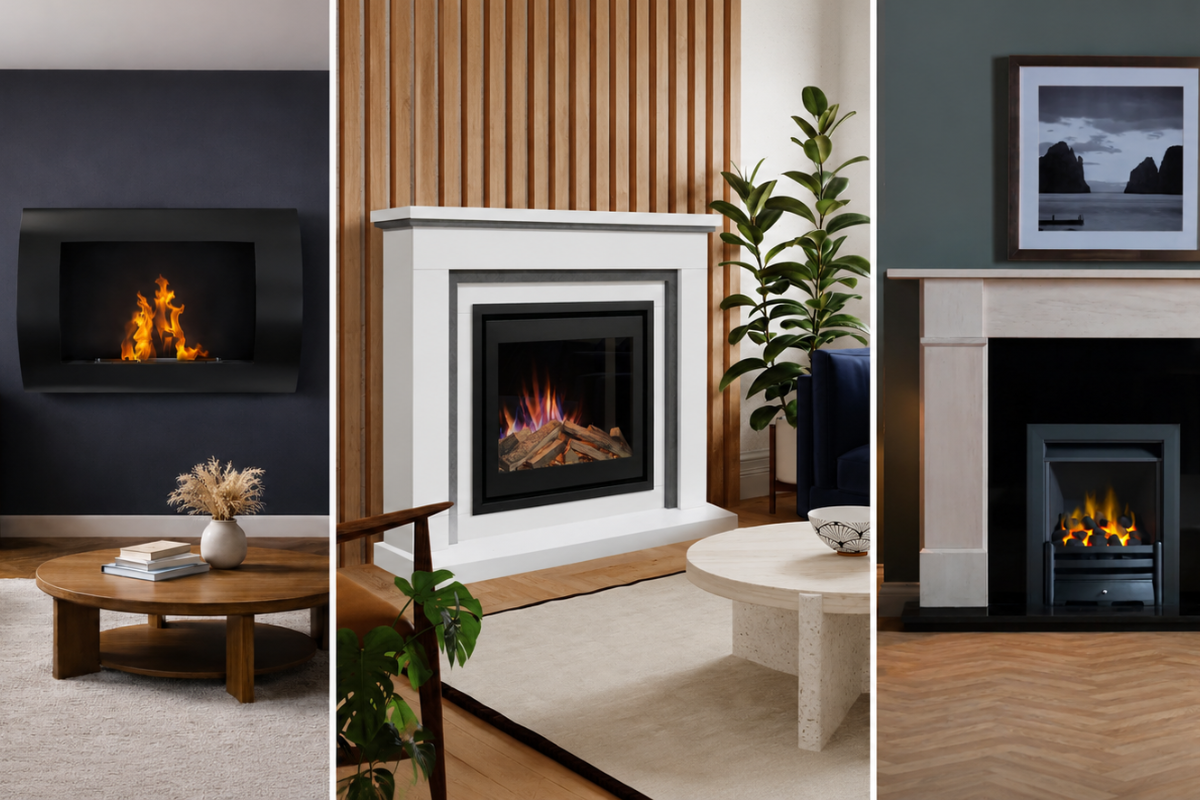
If you want the bottom line right now, here is how the different fireplace types stack up based on current UK energy averages.
| Fireplace type | Estimated cost per hour | General cost position |
|---|---|---|
| Electric | 2p (flame only) to 48p (high heat) | Cheapest for ambience, moderate for heating |
| Gas | 24p to 36p | Cheapest for sustained, high-output heating |
| Bioethanol | £1.05 to £1.75 | Most expensive to run, but cheapest to install |
The Direct Answer:
- Cheapest for occasional use: Electric (especially if using flame-only mode).
- Best for heating larger spaces: Gas (lowest cost per kW of heat).
- Most expensive fuel: Bioethanol.
- Best overall value: Electric for modern, well-insulated homes; Gas for older, draughty properties that need serious heat.
🔑 Key Takeaways
- Electric fires are often cheaper than people expect for short daily use.
- Gas can offer strong value if used regularly for primary room heating.
- Bioethanol fires usually have higher fuel costs, offsetting their cheap installation.
- Usage habits matter more than assumptions — how you use the fire dictates the bill.
- Flame-only modes on electric fires can significantly reduce costs to just pennies an evening.
📍 Jump to section
Wondering which fireplace is cheapest to run? Jump straight to the cost comparisons, real-world examples, and FAQs below.
How We Calculated Running Costs
To give you an accurate fireplace running cost comparison, we have used realistic UK energy prices. Keep in mind that your actual costs will depend on your specific tariff, the exact efficiency of your appliance, and your home's insulation.
Think of the figures below as a reliable guide rather than a guaranteed monthly bill. The better insulated your home is, and the more efficiently you use your fire, the lower your running costs are likely to be.
Our Assumptions:
- Electricity: 24p per kWh (Standard UK average)
- Gas: 6p per kWh (Standard UK average)
- Bioethanol: £3.50 per litre (Buying in standard bulk packs)
| Fuel Type | Assumed Unit Cost | Typical Appliance Input |
|---|---|---|
| Electricity | 24 p / kWh | 1kW to 2kW |
| Mains Gas | 6p / kWh | 4kW to 6kW |
| Bioethanol Liquid | £3.50 / Litre | 0.3L to 0.5L per hour |
Electric Fire Running Costs

Electric fires are incredibly versatile. Because they are 100% efficient at the point of use (every watt of electricity becomes a watt of heat), calculating their running costs is straightforward.
Most modern electric fires have a maximum heat output of 2kW, a low setting of 1kW, and a highly efficient LED flame-only mode.
Electric fire cost per hour:
| Heat setting | Cost per hour |
|---|---|
| Flame only (LEDs) | ~2p |
| Low heat (1kW) | 24p |
| High heat (2kW) | 48p |
Takeaway: Electric fires can be cheaper than expected because many people only use the heat for short periods to take the chill off a room, relying on the flame-only mode for the rest of the evening.
👉 Looking for a low-cost focal point? Browse our Electric Fires category or read our comprehensive Electric Fire Buying Guide.
Gas Fire Running Costs

Gas has historically been the cheapest fuel per kilowatt in the UK. While gas fires lose some heat up the chimney or flue (efficiency ranges from around 70% for open-fronted models to 90%+ for glass-fronted designs), the low cost of the fuel makes them highly economical for sustained room heating.
To achieve a 3kW to 5kW heat output, a gas fire will typically consume between 4kW and 6kW of gas per hour.
| Typical Gas Input | Estimated Heat Output | Cost/hour |
|---|---|---|
| 4kW | ~3.2kW | 24p |
| 5kW | ~4.0kW | 30p |
| 6kW | ~4.8kW | 36p |
Takeaway: If you are using your fireplace to actively heat a large living room every single day, gas is the most cost-effective fuel to do it with.
👉 Need serious heat output? Explore our Gas Fires category or check out our Gas Fires Guide.
Bioethanol Fire Running Costs

A common misconception is that bioethanol fires are the cheapest option overall. People often assume bioethanol is cheaper because installation is easier — requiring no chimney, flue, or gas pipe.
However, while you save hundreds on installation, the ongoing fuel costs are significantly higher. Bioethanol fuel is a premium, clean-burning liquid. A standard burner will use around 0.3 to 0.5 litres per hour, depending on how wide the slider is open.
| Burn setting | Fuel use | Cost/hour |
|---|---|---|
| Minimum | 0.3 Litres/hr | £1.05 |
| Medium | 0.4 Litres/hr | £1.40 |
| Maximum | 0.5 Litres/hr | £1.75 |
Takeaway: Bioethanol is fantastic for architectural freedom and occasional use, but it is not a budget-friendly option for daily, prolonged heating.
👉 Love the flueless design? View our Bioethanol Fires category or read our Bioethanol Fire Buying Guide.
Electric vs Gas vs Bioethanol Running Costs Compared
To help you decide which fire is cheapest to run in the UK for your specific needs, here is a side-by-side comparison.
| Feature | Electric | Gas | Bioethanol |
|---|---|---|---|
| Cost per hour (heating) | 24p – 48p | 24p – 36p | £1.05 – £1.75 |
| Cost per hour (ambience) | ~2p | N/A (always produces heat) | N/A (always produces heat) |
| Heat output | Up to 2kW | Up to 5kW+ | 2kW – 3kW |
| Efficiency | 100% | 70% – 90%+ | 100% |
| Installation needed | Plug in / Hardware | Gas Safe Engineer + Flue | None (Freestanding Wall hung) |
| Best for | Modern homes, media walls | Older homes, primary heating | Occasional use, renters |
Cheapest to Most Expensive
- Electric (Cheapest overall due to flame-only mode and thermostat control
- Gas (Cheapest for high-output, sustained heating)
- Bioethanol (Most expensive to run)
Real-World Running Cost Examples
To remove the guesswork, let’s look at three realistic scenarios to see how electric and gas fire running costs play out over the course of a month.
Scenario 1: The Movie Night User
- Usage: 2 hours per evening, 3 evenings per week (Approx. 24 hours a month). Needs moderate heat.
- Electric (1kW setting): £5.76 per month
- Gas (4kW input): £5.76 per month
- Bioethanol (Medium setting): £33.60 per month
Scenario 2: The Daily Room Heater
- Usage: 5 hours per day, every day (Approx. 150 hours a month). Using the fire instead of central heating.
- Electric (2kW setting): £72 per month
- Gas (5kW input): £45 per month
- Bioethanol (Medium setting): £210 per month
Scenario 3: The Ambience-First Buyer
- Usage: 4 hours per day, purely for the cosy glow (Approx. 120 hours a month).
- Electric (Flame-only mode): £2.40 per month
- Gas: £28.80 per month (Cannot turn heat off)
- Bioethanol: £126 per month (Cannot turn heat off)
Why Efficiency Changes the Answer
Running costs aren’t just about the price of fuel. Several real-world factors dictate what you will actually pay:
- Thermostats: Modern electric and gas fires feature thermostatic remote controls. Once the room hits your desired temperature, the fire drops its output or turns off, meaning a 2kW electric fire rarely draws 2kW for a full hour.
- Room size and heat retention: A well-insulated new build will heat up fast, favouring an electric fire. A draughty Victorian terrace will lose heat quickly, making the raw power and lower fuel cost of a gas fire much more attractive.
- Supplemental vs primary heating: Using a fireplace to heat one room (zone heating) while keeping the central heating off can save you money overall, regardless of whether you choose gas or electric.
Frequently Asked Questions
Which fire is cheapest to run in the UK?
For overall flexibility and occasional use, electric fires are the cheapest to run, largely because you can use the flame effect without the heater for just pennies a day. For daily, heavy-duty heating, gas is the cheapest per kilowatt.
Are electric fires expensive to run?
No, electric fires are not inherently expensive to run. While electricity costs more per unit than gas, electric fires are 100% efficient and feature flame-only modes that cost around 2p per hour.
Is gas cheaper than electric heating?
Per unit of energy (kWh), gas is significantly cheaper than electricity in the UK. If you need to heat a large room for several hours a day, a gas fire will cost less to run than an electric fire on its maximum heat setting.
Why is bioethanol more expensive?
Bioethanol is a specially refined, clean-burning alcohol. Because it is manufactured and bottled as a premium liquid fuel rather than piped into your home via a national grid, the cost per hour of burning it is much higher.
Does flame-only mode use much electricity?
Modern electric fires use LED technology for their flame effects. This draws very little power — usually between 10 and 50 watts — meaning it costs roughly 1p to 2p per hour to run the flames without the heater.
Which fire gives best value overall?
Electric fires offer the best overall value for most modern lifestyles, providing year-round ambience with low running costs. Gas fires offer the best value for those who rely on their fireplace as a primary heat source during winter.
Find the Right Fireplace for Your Budget and Usage
Still unsure which route to take? Let your lifestyle dictate your choice:
Want low ongoing costs and year-round ambience?
Heating a room every day and want the lowest cost per kW?
Want ultimate flexibility, real flames, and no installation fees?
You might also like:
- 👉 What fireplace is best for my living room? (Size, style and layout options)
- 👉 Electric vs gas vs bioethanol fires: Which is right for your home?
- 👉 High-efficiency gas fires explained
- 👉 Electric fireplace suite vs media wall fire
- 👉 Electric fire buying guide
- 👉 What gas fire type is right for you?
- 👉 Bioethanol fire buying guide
- 👉 Gas fire vs central heating: Which should you use?
- 👉 Gas or electric fires: Which is best?
- 👉 How to get a traditional fireplace look in a new build
- 👉 Gas fires without a chimney: What are your options?
- 👉 Is it cheaper to heat one room or the whole house?
- 👉 What’s the most efficient way to heat your home?
↑ Back to top | Jump to sections ↑
